Mostrando postagens com marcador Raiva. Mostrar todas as postagens

segunda-feira, 13 de junho de 2011

UC Davis Children's Hospital patient becomes third person in U.S. to survive rabies


(SACRAMENTO, Calif.) — Precious Reynolds, an 8-year-old resident of rural Humboldt County, has become the third person in the United States known to have recovered from rabies infection without receiving the rabies vaccine, through the efforts of a team of dedicated physicians, nurses and therapists at UC Davis Children's Hospital.
The hospital team was led by Jean Wiedeman, associate professor of pediatric infectious diseases. Wiedeman coordinated Precious' care with state, local and federal officials at the U.S. Centers for Disease Control and Prevention (CDC), the California Department of Public Health's Encephalitis and Special Investigations Section, and county health departments in Humboldt and Sacramento counties.
Dr. Jean Wiedeman (left) and Precious Reynolds (right)
Dr. Jean Wiedeman and Precious Reynolds © UC Regents"Precious received superb care from everyone at UC Davis Children's Hospital," Wiedeman said. "And we were enveloped with support from the CDC and the state encephalitis group from the moment we learned she was infected," Wiedeman said. She said the consultations with national, state and local public-health officials occurred as often as 20 times a day in the early phases of the patient's treatment.
"From the very beginning, Precious had a very rapid, robust immune response to her infection, which is a significant contributor to why she survived," Wiedeman said. "She is truly a fighter."
Rabies is a highly infectious viral disease of mammals that usually is transmitted through the bite or scratch of a rabid animal. Because pets and farm animals typically are inoculated against the disease, exposure commonly comes from a bat, skunk, fox or other wild animal.
While it is not known how she became infected, public health officials suspect Precious may have encountered a feral cat near her elementary school in the tiny town of Willow Creek, Calif., near the Humboldt County border with Trinity County, though the infected animal never was found.
Rabies infection in humans is exceptionally rare in the United States, Wiedeman said, with only two-to-nine cases reported each year. Many more people — some 30,000 annually — are exposed and receive post-exposure prophylaxis (PEP) to prevent disease. 
Reynolds did not receive post-exposure prophylaxis, a series of antiviral inoculations administered following infection, because the date and nature of her exposure is not known. Rabies is virtually always fatal without PEP.
The virus affects the central nervous system, ultimately causing encephalitis, or acute inflammation of the brain, and eventually, death. Very early symptoms of rabies in people include fever, headache, and general weakness or discomfort. As the disease progresses, however, more specificsymptoms appear.
That was the case with Reynolds, according to her grandmother, Shirley Roby.
"It started with a stomach ache," said Roby, who immediately took Precious to the family physician, who suggested she might have appendicitis and recommended she be seen at a local hospital. The hospital ruled out appendicitis and suggested she had a case of the flu.
But as the child's condition continued to decline, she became unable to swallow, and began to feel pain in her neck and back. Eventually she would lose muscle control and the ability to stand or walk. Roby returned Precious to the community hospital.
"This isn't the flu," she told them pointedly. "To me, it looked more like polio."
The hospital transferred the child by ambulance to McKinleyville, Calif., where she was flown to Sacramento and transported to UC Davis Children's Hospital. She was admitted through the pediatric emergency department to the pediatric intensive care unit (PICU).
There, Wiedeman and critical care medicine colleagues, including physicians Jennifer Plant, Theresa Murdock-Vlautin and Mac Wayment, among others, evaluated Precious and determined that she had encephalitis.
Wiedeman specializes in the treatment of children with infectious diseases. She has specific expertise in the management of complex clinical cases, especially those with problematic diagnostic and management intricacies. She provided samples of Precious' blood and spinal fluid to the state Encephalitis and Special Investigations Section of the California Department of Public Health, directed by Carol Glaser, a physician and veterinarian and associate professor of pediatric infectious diseases at UC San Francisco.
Test results returned on May 5 indicated that Precious had rabies. Wiedeman, along with the UC Davis pediatric critical care doctors, the CDC and state encephalitis group, decided to treat her with a therapy first used in Wisconsin in 2004 on a 15-year-old girl who contracted rabies from a bat bite. Her physician placed the girl in a drug-induced coma while administering antiviral medication. There has been one other survivor, a patient in Texas in 2009, who did not receive treatment with this approach.
"This was a unique experience," Wiedeman said. "It was reassuring that the CDC and the state encephalitis group had our back," Wiedeman said. But more difficult was sharing the diagnosis with Roby and Precious' father, Willie Reynolds.
"You're aware that the child has a minimal chance of survival, that the protocol has been applied worldwide in 25 cases with only four survivors. You're not going to the family with good news if you've got a diagnosis of rabies. It's heartbreaking," Wiedeman said.
"None of us thought she would leave the PICU. When she did it was unbelievable," said Krystle Realyvasquez, a nurse who cared for Precious when she was first admitted to the intensive care unit and then before she graduated to the step-down unit.
The protocol requires a team approach to the patient's care. Realyvasquez was among a handful of nurses who treated Precious during her intensive care unit stay. "Being in that team environment, where everybody knows what's going on day-by-day, makes for more uniform care, so that we were better able to provide for her needs," she said.
As time passed, however, Precious' immune response gave Wiedeman and the rest of her health-care team and family reason for hope.
"I was very encouraged that with her diagnosis she continued to interact," Wiedeman said. "She was right there until we deepened her coma significantly. She could respond to you and had brisk pupillary responses throughout the coma. There were subtle signs that she was performing well given her diagnosis."
"To me, the most remarkable and lasting part of this experience is that you had a previously, healthy, very vigorous spunky little girl, who got diagnosed with an almost universally fatal disease, and none the less a dedicated team of physicians and nurses — and her father and grandmother, who never left her bedside — pulled her through this," said Jennifer Plant, assistant clinical professor of pediatric critical care medicine, a key member of the team.
"In a year her grandmother is going to send me a video of her wrestling. I am exceptionally proud and happy."
 Roby said that she never gave up on her granddaughter.
"At first my heart sank to my feet. But I guess doctors have to put on a suit of armor to tell parents the truth," Roby said. "I decided that we were just going to think positive."
Roby's instincts were right. She said that Precious received "excellent, excellent" care for two weeks in the pediatric intensive care unit and later in the general pediatric patient-care unit where she continues to receive treatment. The athletic little girl — a wrestler and rodeo sheep rider or "mutton buster" — is back on her feet and beginning to walk with the help of physical medicine and rehabilitation.
Roby said she that she is grateful to everyone who has cared for her granddaughter — particularly Wiedeman, for her devoted care for Precious.
"She fought for Precious tooth and nail," Roby said. "She is something special to me."
Wiedeman and Roby cautioned parents to admonish their children to avoid any and all contact with wild or feral animals — including dead ones — particularly bats. If exposed, Wiedeman said, rabies is completely preventable with a vaccine that is far more sophisticated than the multiple painful inoculations of the past.
 Roby agreed.
"Talk to your kids about any kind of animal scratching or biting them. The shots don't hurt. They're a little expensive — but not half as expensive as having a loved one go through this."
UC Davis Children's Hospital is the Sacramento region's only comprehensive hospital nationally ranked by U.S. News and World Report. It serves children, serving infants, children, adolescents and young adults with primary, subspecialty and critical-care services and includes the Central Valley's only pediatric emergency department and level I pediatric trauma center, which offers the highest level of care for critically ill children. The 110-bed "hospital within a hospital" includes a 49-bed, state-of-the-art neonatal intensive care unit and a 16-bed pediatric intensive care unit. With more than 120 physicians in 33 subspecialties, UC Davis Children's Hospital has more than 74,000 clinic and hospital visits and 13,000 emergency department visits each year. For more information, visitchildren.ucdavis.edu.

sexta-feira, 27 de maio de 2011

Rabies Survivor: Girl from USA


Willow Creek girl becomes one of the few who’ve ever lived through the deadly virus

(MAY 26, 2011)  It started with a stomachache. Eight-year-old Precious Reynolds, who lives in Willow Creek with her grandparents, three siblings and a cousin, had been complaining about tummy troubles, so her grandpa took her to the local clinic. Assuming she had the flu, her doctor advised the usual treatment — rest, fluids — and sent her home.
Soon, new symptoms began to appear. Around 3 in the morning on Saturday April 30, Precious woke her grandparents complaining that her neck and back were hurting. “I thought she might have just slept on it wrong, so I told her to go back and lay down,” her grandmother, Shirley Roby, told the Journal by phone Tuesday. Come daylight, however, Precious wasn’t any better, so her grandpa drove her over the hill to Mad River Hospital.
Doctors performed tests but, given her stomachache and muscle soreness, they, too, assumed Precious had the flu. Once again her grandpa brought her home. “At lunch time, I was fixing all the kids lunch, and [Precious] said she felt like she was gonna get sick to her stomach,” Roby recalled. “She got up from the table and her legs just collapsed on her. She looked at me surprised. She just wasn’t functioning right.”
The family helped Precious to the couch, and over the next few hours they kept offering her water. But every time Precious took a sip she would vomit it back up. By 8 p.m. she couldn’t talk and was barely moving. Around 10 p.m. Roby tried to prop Precious upright on the couch, but she immediately slumped over, “like she was paralyzed.” That’s when Roby knew something was seriously wrong. “I said, ‘This is no damn flu.’”
Indeed it wasn’t. The following morning, Precious was flown 200 miles south to the U.C. Davis Medical Center where, almost a week later, doctors determined that she’d been infected with rabies.
Human rabies cases have become exceedingly rare in the United States, thanks in large part to vaccinations of domestic animals. The most recent human case in California was nine years ago, according to the California Department of Public Health (CDPH). Precious’ case is the first from Humboldt County.
The viral disease affects the central nervous system and is typically transmitted to humans from the bite of a rabid animal (bats and skunks are most common, though any mammal can contract the disease). After infection, symptoms can appear in as little as nine days, or they can take a year or more to show up. At first these symptoms are typical of many illnesses — fever, headache, general malaise — but as the disease progresses it starts to cause neurological problems. These vary dramatically from case to case, but they can include insomnia, anxiety, confusion, fear of water, partial paralysis, difficulty swallowing, hallucinations and more. Once these symptoms appear, death from respiratory failure is usually imminent.
“Up until a few years ago we would have said quite definitively that rabies is 100 percent fatal,” said Dr. Curtis Fritz, a public health veterinarian with the CDPH. The first human ever to survive rabies without a vaccination was a Wisconsin teenager named Jeanna Giese. The 15-year-old made worldwide headlines in 2004 after doctors saved her life by medically inducing a coma to protect the brain while her body fought off the virus. This method, which came to be called the Milwaukee protocol, is exactly what doctors at U.C. Davis used to save Precious.
 When she arrived at the hospital on May 1 she was already in critical condition, Roby said. According to Dr. Fritz, rabies is difficult to diagnose in living patients. Typically the disease is identified using a brain sample. “Obviously we can’t do that in a living patient,” Fritz said. Alternative measures involve looking for antibodies in the blood, cerebral-spinal fluid, saliva or corneal tissue (from the eyeball).
Though Precious had never mentioned being bitten by an animal, one of her doctors suspected rabies and called for the tests. (Later, Precious’ friends and siblings said they’d seen Precious playing with feral cats near her school.) The U.S. Centers for Disease Control confirmed the rabies diagnosis on May 6.
“She was fighting for her life right then and there,” Roby said. Even after the diagnosis, the doctors were pessimistic. They warned Roby and the rest of Precious’ family to expect the worst. “I was scared,” Roby admitted, her voice quivering. “I thought I was gonna lose her. I had never been around anything like this, but I knew she was a fighter.”
Literally, as a matter of fact; Precious loves athletics — wrestling in particular. Three years ago, Roby and her husband took guardianship of Precious, along with her sister and two brothers. The kids’ dad had warrants out for his arrest, and both parents were on drugs. As if that wasn’t enough, Precious has had a heart condition since birth — Supraventricular tachycardia, which sometimes makes her heart beat exceedingly fast, 260-280 times per minute. Yet through all this, Precious has remained outgoing and happy. “She’s one tough little cookie,” Roby said.
And so, despite the doctor’s warnings, Roby put her trust in her granddaughter’s resilient spirit. “Every day grandma would tell her, I’d say, ‘Precious, you got a bad bug inside of you.’ I’d say, ‘I want you to take him, throw him down, put him in a half-nelson, flip him over, get on his chest and smash him into that mat.’ I don’t know if that’s part of what brought her back or not, but we were fighting.”
Finally, doctors brought Precious out of her coma, and according to Roby, they’ve been simply amazed at the speed of her recovery. How do they explain it? “They can’t,” Roby said. “They said she has written a new chapter in the book.” Precious is now the seventh patient in the world to survive rabies, doctors told Roby, and nobody has progressed faster. Monday night she was moved from intensive care to pediatrics, and she’s speaking again — albeit in a whisper. Roby expects that her granddaughter will be ready to come home before too long.
The most important thing people can take away from this, Roby said, is to learn about the dangers associated with rabies so they don’t have to go through what Precious and her family have been through: Have your pets vaccinated, avoid contact with wildlife, and if you do get bit or scratched, treat the wound thoroughly and notify your doctor.

sexta-feira, 25 de março de 2011

País retoma campanha da vacina antirrábica


A campanha de vacinação contra raiva em cães e gatos, que estava suspensa desde o ano passado por causa de mortes e reações adversas exageradas nos animais, será retomada em todo o País em duas etapas. O Estado de São Paulo começará a receber as doses da vacina do Ministério da Saúde a partir de julho - que desta vez não serão fornecidas pelo laboratório Biovet.
A vacina do ano passado, que era de cultivo celular e considerada de ponta, provocou problemas em 637 animais do País, segundo o Ministério da Saúde. Desse total, 41,6% (265 bichos) tiveram ocorrências graves que levaram à morte ou provocaram fortes reações adversas. Desta vez, o fornecedor será o Instituto de Tecnologia do Paraná.
Em agosto de 201 Q, por causa dos problemas ocorridos em São Paulo, revelados à época pelo JT, a secretaria de Estado da Saúde suspendeu a vacinação em todos os municípios. Foi o único Estado a tomar essa medida. Em outubro, foi a vez do Ministério da Saúde recomendar a suspensão para todo o País.
O cancelamento da campanha pelo Governo Federal se deu após resultados de testes em camundongos que demonstraram que o medicamento era insatisfatório em relação à capacidade de não produzir reações inesperadas.
Com o recebimento das novas doses, os municípios farão seus calendários de aplicação - que poderá ocorrerem setembro e não em agosto, como é de praxe. ::


Eis o link para baixar o informe técnico:
http://xa.yimg.com/kq/groups/23157480/177224371/name/INFORME+T%C3%89CNICO+-+MAR%C3%87O+2011.pdf

terça-feira, 22 de março de 2011

Artigo do diagnóstico de raiva em um veterinário que manipulou herbívoros em Minas Gerais

Informação recebida por e-mail:


Prezado(a)s,

Para conhecimento e divulgação. Segue o link do artigo do diagnóstico
de raiva em um veterinário que manipulou herbívoros em Minas Gerais.
Fica mais uma vez o alerta para a necessidade do esquema de
pré-exposição e titulação de anticorpos para prevenção da raiva em
grupos considerados de risco.

http://www.scielo.br/pdf/rimtsp/v53n1/v53n1a07.pdf

Att,
Marcelo Yoshito Wada
Técnico Especializado
Grupo Técnico de Doença de Chagas e Raiva
Unidade Técnica de Zoonoses Vetoriais e Raiva (UVR)
Coordenação Geral de Doenças Transmissíveis (CGDT)
Departamento de Vigilância Epidemiológica (DEVEP)
Secretaria de Vigilância em Saúde/ Ministério da Saúde (SVS/MS)
Fone: (XX61) 3213-8152 //8175 // 8148 // 8118 // 8095
Fax: (61) 3213-8184 // 8140
Email para raiva: raiva@saude.gov.br
Email para chagas: chagas@saude.gov.br
www.saude.gov.br/svs

www.worldrabiesday.org

quinta-feira, 6 de janeiro de 2011

Public Health Response to a Rabid Dog in an Animal Shelter --- North Dakota and Minnesota, 2010


Weekly

January 7, 2011 / 59(51);1678-1680

On March 31, 2010, the North Dakota Department of Health (NDDoH) was notified by a local public health department that a stray dog found in rural Minnesota and housed during March 9--20 in a North Dakota animal shelter had been found to have rabies. NDDoH, along with the local public health department, the North Dakota Board of Animal Health (BOAH), the Minnesota Board of Animal Health, and the Minnesota Department of Health, immediately began an investigation to identify persons requiring rabies postexposure prophylaxis (PEP) and to prevent further rabies transmission. This report summarizes the public health investigation, which used animal shelter records and public notification to identify possible human and animal contacts of the rabid dog. Among 32 persons who might have been exposed to the rabid dog at the shelter, 21 persons, including nine shelter employees and one volunteer, received PEP. In accordance with 2009 Compendium of Animal Rabies Prevention and Control guidance (1), the 25 dogs in the shelter with the rabid dog were euthanized. Among 25 other dogs without an up-to-date rabies vaccination that were adopted or claimed from the shelter and might have been exposed, 11 were euthanized, 13 were isolated for 6 months in their owners' homes, and one was unintentionally killed. No additional cases of rabies in dogs or humans had been identified as of December 2010. This event supports consideration of preexposure vaccination of animal shelter employees and highlights the continued importance of routine rabies vaccination of domestic animals.
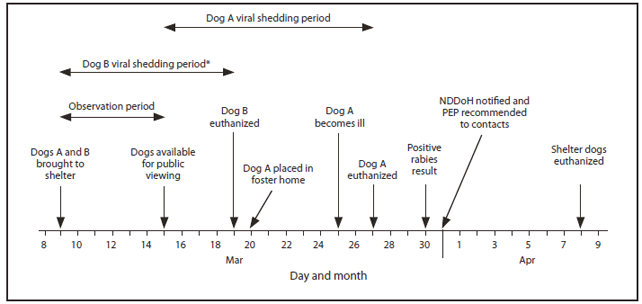
On March 9, 2010, two stray dogs found by a sheriff's deputy in Marshall County, Minnesota, were brought to an animal shelter in Grand Forks, North Dakota. Marshall County is a rural area of Minnesota, and Grand Forks offers the closest animal shelter. In accordance with animal shelter protocol and city ordinance, the dogs were isolated from other animals in the shelter for 5 days. During this time, the dogs were observed for signs of disease or behavioral abnormalities. Dog A was fearful of shelter staff members and dependent on dog B, which was dominant, aggressive, and larger than dog A. On March 15, after the 5 days of isolation, the two dogs were transferred to the area holding the general shelter population and made available for adoption. Because of its dominant and aggressive temperament, however, dog B was deemed unsuitable for adoption and euthanized on March 19. On March 20, dog A was placed with a foster family in North Dakota. Five days later, the dog was vomiting and had loss of balance. On March 27, the family returned the dog to the shelter, where it was examined by a veterinarian, who noted hyperesthesia, tremors, ataxia, and dilated pupils. Because the differential diagnosis included canine distemper and rabies, the dog was euthanized the same day, and the brain was sent to the state veterinary diagnostic laboratory for testing. Three days later, the laboratory reported that a fluorescent antibody test was positive for rabies virus. CDC confirmed the result and characterized the virus as a North Central skunk rabies virus variant.
The animal shelter that housed the rabid dog takes in approximately 35--40 animals per week and can house up to 125 animals. The shelter is operated by the local humane society and also serves as the city pound, under a contract with Grand Forks. Dogs are kept in kennels constructed with concrete walls to minimize contact between dogs. Dogs are taken out of the kennels on leashes, and employees and volunteers are instructed to prevent contact between dogs. However, shelter employees could not verify that this policy was strictly followed while dogs A and B were at the shelter.
Employees, volunteers, and visitors to the animal shelter could have been exposed to rabies during March 9--20 while either dog was in the shelter (Figure). Dog B was presumed to be rabid, based on the close relationship with dog A and the possibility that they both were exposed to rabies virus at the same time. In addition, anyone in contact with dog A while it was with the foster family during March 20--27 also was at risk. A review of employee records and volunteer logs identified 32 persons who might have been exposed to the dogs at the shelter. Nine animal shelter employees and one volunteer received PEP. Eleven other persons received PEP, including the five members of dog A's foster family and one neighbor child, three members of the family who found dogs A and B in Minnesota, and two children who visited the shelter. In total, 21 persons received PEP. Of the 15 persons whose exposures were documented, all were licked by one of the dogs, and five had open wounds on their hands. As of December, no contacts had developed rabies.
The second phase of the public health investigation involved identifying animal contacts of the dogs. Although the shelter's animal handling policies likely minimized contact among dogs, muzzle-to-muzzle contact could not be ruled out; therefore, BOAH and NDDoH recommended that all dogs present in the shelter from March 9--20 be euthanized. All 25 dogs remaining in the shelter were euthanized. Adoption and claimed pet records were used to identify 37 other dogs that had been in the shelter during March 9--20, including 31 in North Dakota, five in Minnesota, and one in Michigan. Among those dogs, 12 were up-to-date on rabies vaccination, including one in Minnesota and one in Michigan. Of the 25 dogs without documented rabies vaccination, the owners of 11 opted to euthanize them, and the owners of 13 decided to confine their dogs for 6 months of observation. One dog in North Dakota was unintentionally killed before a decision was made. All euthanized dogs tested negative for rabies. No additional cases of rabid animals related to possible shelter exposure had been identified as of December 2010.

Reported by

K Kruger, T Miller, MPH, M Feist, North Dakota Dept of Health; S Keller, DVM, B Carlson, DVM, North Dakota State Board of Animal Health; R Klockmann, Grand Forks Public Health Dept. S Schwabenlander, DVM, Minnesota Board of Animal Health; J Scheftel, DVM, Minnesota Dept of Health. C Rupprecht, VMD, PhD, Div of High-Consequence Pathogens and Pathology, National Center for Emerging and Zoonotic Diseases; JR Cope, MD, B Petersen, MD, EIS officers, CDC.

Editorial Note

The case described in this report demonstrates the risk for rabies virus transmission from domestic animals and the importance of vaccination and stray animal control programs in decreasing that risk. In the United States, such programs have succeeded in eliminating the canine rabies virus variant and decreased the number of laboratory-confirmed cases of rabies in dogs from 6,949 in 1947 to 75 in 2008 (1,2). Nevertheless, reintroduction of the canine rabies virus variant remains a threat, as illustrated by the importation of a rabid dog from Iraq in 2008 (3). In addition, rabies virus in indigenous wildlife reservoirs throughout the United States can be transmitted the virus to unprotected domestic animals, as probably occurred in the case described in this report.
Vaccination and animal control programs are the best strategies to protect against rabies and the resulting public health consequences. Rabid domestic animals have the potential to affect public health resources substantially. For example, the total cost to respond to a single rabid dog in California in 1980 was estimated to be $105,790 (4). A similar situation in 1994 involving a single rabid kitten purchased from a pet store led to a total of 665 persons receiving PEP at an estimated overall cost of $1.5 million (5). The identification of a rabid animal in any such public setting should prompt an immediate response to investigate potential exposures and institute prevention and control efforts to protect the health of the public.
Rabies virus is transmitted by bites from a rabid animal or by saliva or other potentially infectious material (e.g., neural tissue) that is introduced into fresh, open cuts in skin or onto mucous membranes (6,7). Activities such as petting an animal; contact with the blood, urine, or feces of an animal; or contact of saliva with intact skin are not exposures and therefore do not require PEP (6,7). Development of a standardized risk assessment with strict application of these exposure definitions might decrease the number of persons receiving PEP in any rabies exposure situation, including this one, in which all exposures of persons receiving PEP were not documented fully. In addition, preexposure prophylaxis for animal shelter workers or other persons whose activities bring them into frequent contact with potentially infected animals should be considered, in accordance with Advisory Committee on Immunization Practices recommendations (6). Preexposure prophylaxis consists of 3 doses of vaccine administered on days 0, 7, and 21 or 28 (6,7). Although the initial cost can be a concern, preexposure prophylaxis decreases costs for PEP after a subsequent exposure by obviating the need for rabies immunoglobulin, reducing the number of vaccine doses from 4 to 2, and decreasing the number of visits to a health-care provider. Preexposure prophylaxis also might help protect persons from unrecognized exposures or offer partial immunity when PEP is delayed.
Several measures should be instituted in animal shelters and other public settings where humans are exposed to animals to decrease the risk for rabies virus transmission and to facilitate the epidemiologic investigation of identified cases. First, all domestic animals should be vaccinated against rabies, in accordance with guidelines (1,8). Second, animals without documentation of vaccination against rabies should be kept separate from the public, wildlife, and other animals to prevent transmission of the virus (5,8). In this case, 36 dogs had to be euthanized because employees and volunteers might not have consistently followed the shelter's policy of preventing muzzle-to-muzzle contact between dogs. Third, each facility should maintain adequate records, including rabies vaccination certificates, animal source documentation, and adoption and sales records, to facilitate the investigation of any possible exposures. Strict adherence to these recommendations will protect humans from exposures and also can protect animals involved with an exposure from being euthanized.

Acknowledgments

This report is based, in part, on contributions by staff members of the Grand Forks Public Health Dept, A Moen, Circle of Friends Humane Society, S Hansen, J Hargreaves, DO, Altru Health System, Grand Forks, North Dakota; L VanderBusch, T Hardy, North Dakota Dept of Health; and L Orciari, MS, and P Yager, Div of High-Consequence Pathogens and Pathology, National Center for Emerging and Zoonotic Diseases, CDC.

References

  1. CDC. Compendium of animal rabies prevention and control, 2008: National Association of State Public Health Veterinarians, Inc. (NASPHV). MMWR 2008;57(No. RR-2).
  2. Blanton JD, Robertson K, Palmer D, Rupprecht CE. Rabies surveillance in the United States during 2008. J Am Vet Med Assoc 2009;235:676--89.
  3. CDC. Rabies in a dog imported from Iraq---New Jersey, June 2008. MMWR 2008;57:1076--8.
  4. CDC. The cost of one rabid dog---California. MMWR 1981;30:527.
  5. CDC. Mass treatment of humans exposed to rabies---New Hampshire, 1994. MMWR 1995;44:484--6.
  6. CDC. Human rabies prevention---United States, 2008: recommendations of the Advisory Committee on Immunization Practices. MMWR 2008;57(No. RR-3).
  7. CDC. Use of a reduced (4-dose) vaccine schedule for postexposure prophylaxis to prevent human rabies: recommendations of the Advisory Committee on Immunization Practices. MMWR 2010;59(No. RR-2).
  8. CDC. Compendium of measures to prevent disease associated with animals in public settings, 2009: National Association of State Public Health Veterinarians, Inc. (NASPHV). MMWR 2009;58(No. RR-5).

What is already known on this topic?
Rabies is a lethal zoonotic disease typically transmitted through a bite from an infected mammal.
What is added by this report?
This report describes the epidemiologic investigation and public health response to a rabid dog identified in an animal shelter and the associated administration of postexposure prophylaxis to 21 persons and euthanization of 36 dogs.
What are the implications for public health practice?
Animal shelters should ensure that adopted animals are vaccinated against rabies, consider preexposure prophylaxis for employees and volunteers, and prevent contact between unvaccinated animals to decrease the risk for rabies virus transmission.

FIGURE. Timeline of events leading to identification of a rabid dog in an animal shelter and resulting public health response --- North Dakota and Minnesota, March--April 2010
The figure shows the timeline of events leading to identification of a rabid dog in an animal shelter and resulting public health response in North Dakota and Minnesota during March-April 2010. According to the figure, employees, volunteers, visitors, and other dogs in the animal shelter could have been exposed to rabies during March 9-20 while the dog and a companion dog were in the shelter. Persons who had contact with the dog also might have exposed before the dog was euthanized on March 27.
Abbreviations: PEP = postexposure prophylaxis; NDDoH = North Dakota Department of Health.
* Based on presumptive diagnosis of rabies.
Alternate Text: The figure above shows the timeline of events leading to identification of a rabid dog in an animal shelter and resulting public health response in North Dakota and Minnesota during March-April 2010. According to the figure, employees, volunteers, visitors, and other dogs in the animal shelter could have been exposed to rabies during March 9-20 while the dog and a companion dog were in the shelter. Persons who had contact with the dog also might have exposed before the dog was euthanized on March 27.

segunda-feira, 29 de novembro de 2010

NOTA TÉCNICA N.º 161 /2010 – DEVEP/SVS/MS - Vacina contra a Raiva

MINISTÉRIO DA SAÚDE
SECRETARIA DE VIGILÂNCIA EM SAÚDE
DEPARTAMENTO DE VIGILÂNCIA EPIDEMIOLÓGICA
Esplanada dos Ministérios, Edifício Principal, 2º andar
70.304-000 Brasília-DF
Tel. (061) 3213 - 8095
NOTA TÉCNICA N.º 161 /2010 – DEVEP/SVS/MS

Assunto: Atualização sobre a vacina contra raiva canina e felina - RAI-PET® do laboratório Bio-Vet – 29/11/2010

1. Esta nota técnica foi elaborada a fim de esclarecer as ações adotadas pelos Ministérios da Saúde e da Agricultura, Pecuária e Abastecimento (MAPA) frente aos relatos de eventos adversos ocorridos após o uso da vacina contra raiva “RAI-PET® – Vacina contra a Raiva Inativada” fabricada pelo laboratório Bio-Vet e licenciada no MAPA sob o número 8657/2003.

2. Há 30 anos, o Ministério da Saúde, adquire do laboratório TECPAR a vacina anti-rábica animal para utilização na Campanha Nacional de Imunização de Cães e  Gatos. A partir de 2009, esse laboratório iniciou o processo de desenvolvimento de uma nova tecnologia de fabricação, passando da vacina tipo Fuenzalida & Palacios para a de cultivo celular, sendo esta última uma vacina comprovadamente de maior imunogenicidade.
Entretanto, dificuldades no processo de incorporação dessa tecnologia inviabilizaram sua produção. Por esse motivo, o TECPAR forneceu ao Ministério da Saúde as partidas nºs 059/2010, 139/2010, 177/2010 e 213/2010 da vacina RAI-PET®. As partidas foram previamente avaliadas e aprovadas pelo Ministério da Agricultura, Pecuária e Abastecimento.

3. Após o início da vacinação, foi relatada ao Ministério da Saúde a ocorrência de eventos adversos nos estados de São Paulo e Rio de Janeiro. Para acompanhar essa situação em todo o país, o Ministério da Saúde criou um instrumento de monitoramento dos eventos adversos associados temporalmente ao uso da vacina contra raiva animal, que passaram a ser notificados no formulário eletrônico “Notificação de Evento Adverso Temporalmente Associado à Vacinação Contra a Raiva Animal”, disponível no site www.saude.gov.br/svs

4. A partir das notificações do Ministério da Saúde, o Ministério da Agricultura, Pecuária e Abastecimento promoveu a colheita de amostras das quatro partidas (059/10, 139/10, 177/10 e 213/10) do produto de uso veterinário “RAI-PET® - Vacina contra a Raiva Inativada”, nos locais indicados pelo Ministério da Saúde (Rio de Janeiro e São Paulo), a fim de avaliar se essas partidas poderiam apresentar resultados diferentes daqueles encontrados antes da liberação do produto para a rede de saúde.

5. As amostras foram retestadas pelo LANAGRO/SP, onde foram submetidas a testes de vírus residual (para checar se havia presença de vírus ativo de raiva); esterilidade (que detecta se há contaminação por bactéria ou fungo); e inocuidade (que verifica se a vacina causa algum efeito adverso não esperado). Os testes são realizados com a aplicação da vacina em camundongos, em conformidade com o regulamento técnico para produção e controle da qualidade de vacinas contra raiva, previsto na Portaria Ministerial nº 228, de 1988, disponível no site www.agricultura.gov.br

6. Até a presente data, foram emitidos resultados finais referentes as 16 amostras testadas, sendo que quatro amostras de uma partida, a 059/10, apresentaram resultado insatisfatório no que concerne à prova de inocuidade.

7. Como nas amostras da partida nº059/10, os resultados em relação à inocuidade foram discrepantes, não foi possível chegar a uma conclusão sobre o motivo da alteração constatada nessas amostras, e, diante desse fato, o Ministério da Agricultura, Pecuária e Abastecimento encaminhou para estudos no laboratório de patologia clínica da Universidade de São Paulo – USP, tecidos dos camundongos que apresentaram eventos adversos não esperados. Esses estudos poderão indicar a causa do aumento do índice de eventos adversos, e se esses eventos foram provocados pelo uso das partidas de vacina contra raiva citadas.

8. O sistema de monitoramento do Ministério da Saúde registrou os seguintes dados:
·         A ocorrência de 637 eventos em 17 Unidades Federadas, sendo que o intervalo entre a vacinação e o início dos sintomas foi em média de um dia e mediana de zero dia (0 a 34 dias). Dos eventos classificados quanto à natureza clínica, observou-se que 41,6% (265/637) eram graves.
·         Dentre os graves, 74% (196/265) ocorreram em cães e 26% (69/265) em gatos. No que refere à idade e porte dos animais, 39,2% (104/265) ocorreram em menores de um ano de idade e 50,2% (133/265) em animais com menos de 10 kg, respectivamente. Com relação à evolução do caso, 76,2% (202/265) foram a óbito, além disso, foram relatados sintomas até então não descritos na literatura e na bula da vacina RAIPET ®, como hemorragia.
·         Dos 265 eventos graves ocorridos, identificou-se a numeração da partida em 73,2%, dos quais 68,6% (133/194) estão relacionados à partida nº 059/10; 21,1% (41/194) à partida nº 177/10; e 10,3% (20/194) à partida nº 139/10.
·         Com relação à taxa de eventos graves, foram identificados os seguintes valores: partida nº 059/10 – 0,1/1.000 (80/794.023); partida nº 139/10 – 0,03/1.000 (12/427.136) e partida nº 177/10 – 0,04/1.000 (20/547.756).
·         Os animais vacinados com a partida nº 059/10 apresentaram risco relativo de 1,42 (1,16 – 1,76) de apresentar forma grave de evento adverso, dentre todos aqueles que tiveram evento adverso. Já em relação à evolução do caso para o óbito, os animais vacinados com a partida nº 059/10, apresentaram risco relativo de 1,59 (1,25 – 2,02) em comparação com as outras partidas.
·         Segundo avaliação estatística realizada pela equipe técnica do Ministério da Saúde, a partir do estudo caso-controle, em que foram avaliados os eventos adversos graves e a partida utilizada, foi possível verificar que os animais vacinados com a partida nº 059/10 apresentaram uma maior chance de desenvolver eventos adversos graves: Odds Ratio: 3,53 (2.33 – 5.36).
·          
9. A partir da notificação desses fatos ao TECPAR, no dia 25 de novembro de 2010, a referida empresa decidiu pela reposição ao Ministério da Saúde de todas as vacinas ainda não utilizadas.

10. As Secretarias de Estado de Saúde deverão seguir a seguinte orientação, quanto às partidas de vacina abaixo relacionadas:

·         Em função do resultado encontrado nas avaliações laboratoriais da partida nº 059/10 e dos estudos epidemiológicos efetuados, decidiu-se pela suspensão definitiva do seu uso na rede pública de saúde, e o quantitativo da referida partida existente nos estados e municípios deverá ser destruído, adotando-se todos os procedimentos legais necessários por parte do Ministério da Saúde e Secretarias Estaduais e Municipais de Saúde.
·         Recolher as vacinas RAI-PET® das partidas 139/10 e 177/10 existentes nos municípios, mantendo-as na Central de Armazenamento de Imunobiológicos nos Estados, em condições adequadas de uso, para que o TECPAR possa realizar o devido recolhimento.
·         Todo o quantitativo a ser incinerado ou recolhido deverá ser informado à Coordenação Geral de Imunizações até o dia 15/12/2010.
·          
11. Inicialmente, o Ministério da Saúde receberá do TECPAR o quantitativo de três milhões de doses de vacina contra raiva animal, que deverão atender exclusivamente as ações de bloqueio de foco, que serão posteriormente esclarecidas pelo Ministério da Saúde.
Os demais quantitativos da vacina serão substituídos em 2011, em cronograma a ser apresentado pela empresa.

12. O Ministério da Agricultura, Pecuária e Abastecimento – MAPA esclarece ainda:
·         Após realização de auditoria no sistema de produção da empresa Bio-Vet, constatou-se que não ocorreram alterações na metodologia de produção e de controle da qualidade que justifiquem o aparecimento desses eventos adversos.
·         Vale ressaltar que 100% das partidas da vacina fabricadas e importadas são testadas em laboratórios oficiais antes de serem comercializados, para avaliação da segurança e eficácia e, na ocasião, não foi detectado nenhum problema no processo produtivo da vacina anti-rábica canina.

Brasília, 29 de novembro de 2010.
Ministério da Saúde
Ministério da Agricultura, Pecuária e Abastecimento